


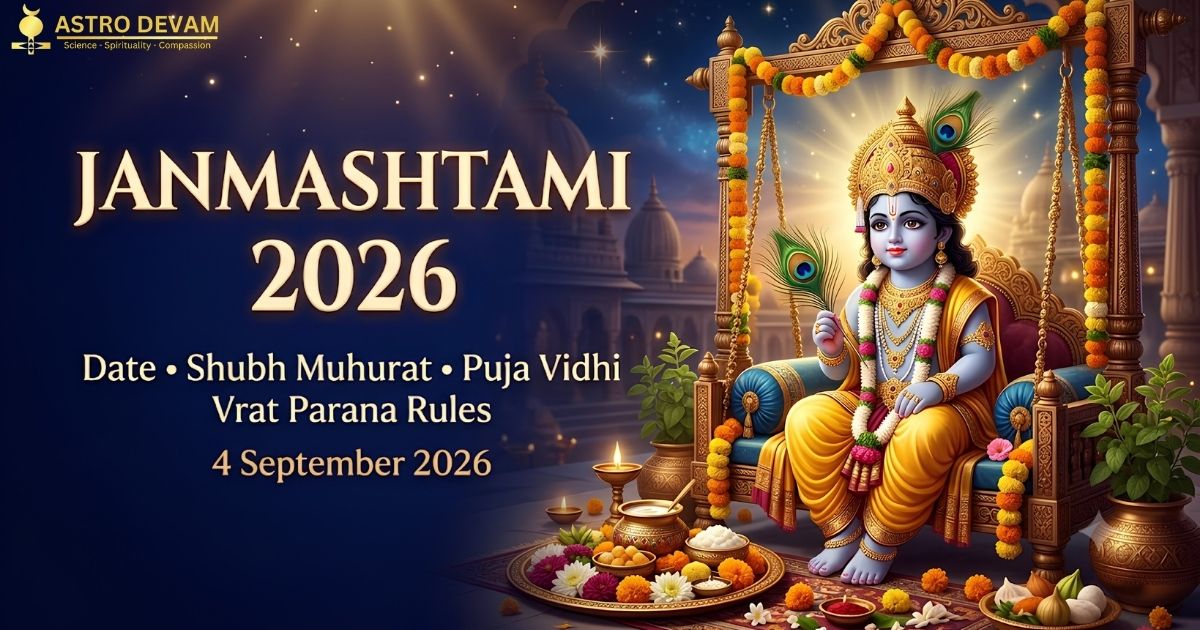
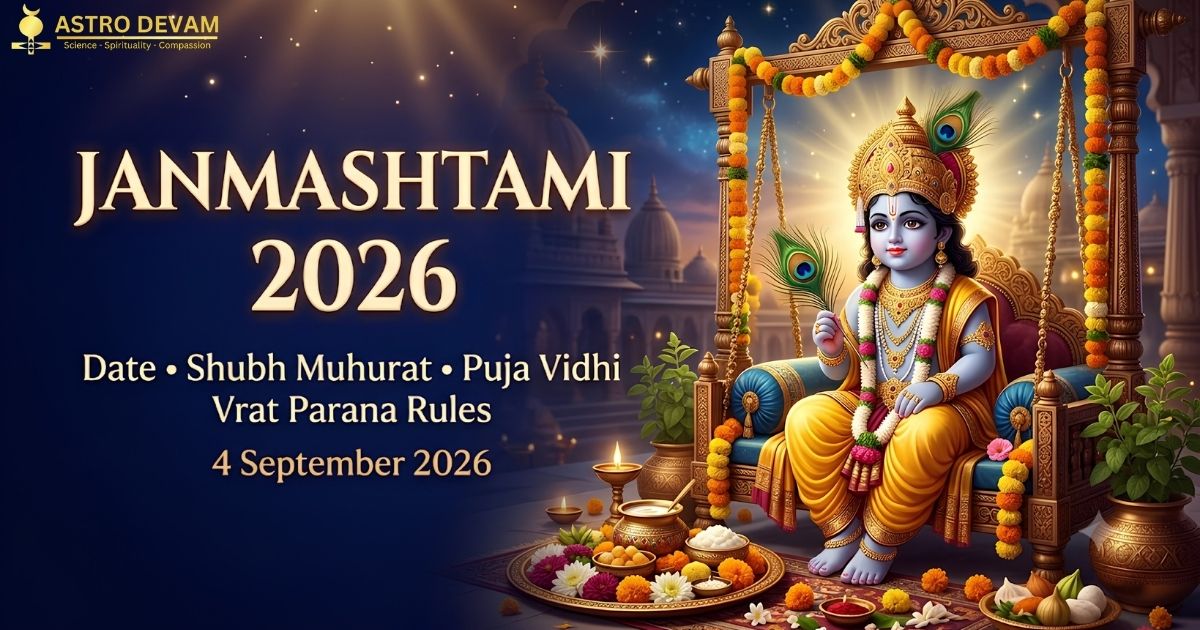
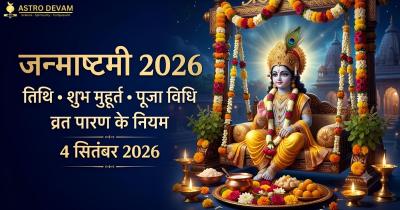
Janmashtami 2026: Date, Shubh Muhurat, Puja Vidhi, and Vrat Parana Rules Explained
Most devotees who observe the sacred fast on Krishna Janmashtami end up breaking their vrat at the wrong time—not out of neglect, but because the rules governing Parana (breaking the fast) are among the most misunderstood aspects of the entire festival.
Celebrating the 5253rd birth anniversary of Lord Krishna in 2026, this guide provides the verified date, exact Panchang timings, step-by-step Shodashopachara Puja Vidhi, fasting directives, and the classical Dharma Shastra rules for breaking your fast correctly.
What is Janmashtami?
Janmashtami (also widely known as Krishnashtami, Gokulashtami, Ashtami Rohini, Sri Krishna Jayanti, and Sree Jayanthi) marks the divine birth of Lord Krishna, the eighth avatar of Lord Vishnu. According to Vedic scriptures, Lord Krishna manifested at midnight inside a prison cell in Mathura to Devaki and Vasudeva to destroy tyranny and re-establish Dharma.
Across India and globally, devotees observe day-long fasts, decorate elaborate cradles (Jhulas), sing devotional bhajans, and perform elaborate midnight rituals during the exact astronomical period of his birth.
Date and Shubh Muhurat of Janmashtami According to Hindu Calendar
The date of Janmashtami in 2026 is confirmed for Friday, September 4, 2026. The vibrant festival of Dahi Handi will be celebrated the following day, on Saturday, September 5, 2026.
Key panchang timings for Janmashtami 2026:
- Nishita Puja Muhurat: 11:57 PM (Sep 04) to 12:43 AM (Sep 05) (Duration: 45 Minutes)
- Vedic Midnight Moment (Nishita Kaal): 12:20 AM (Sep 05)
- Moonrise (Chandrodaya Moment): 11:29 PM (Sep 04)
- Ashtami Tithi Begins: 02:25 AM on September 04, 2026
- Ashtami Tithi Ends: 12:13 AM on September 05, 2026
- Rohini Nakshatra Begins: 12:29 AM on September 04, 2026
- Rohini Nakshatra Ends: 11:04 PM on September 04, 2026
Why is Janmashtami Celebrated on Two Days?
A frequent source of confusion is why Janmashtami often appears on two consecutive days on Hindu calendars. This occurs due to differing calculation rules between two primary Hindu traditions: Smarta Sampradaya and Vaishnava Sampradaya.
1. Smarta Sampradaya: Smartas (householders who follow classical Smriti texts like Dharmasindhu and Nirnaysindhu) prioritize Nishita Kaal (Vedic midnight). They observe Janmashtami on the day when Ashtami Tithi prevails during midnight, incorporating Rohini Nakshatra rules. Their date can fall on either Saptami or Ashtami Tithi.
2. Vaishnava Sampradaya: Followers of Vaishnavism prioritize the concurrence of Ashtami Tithi and Rohini Nakshatra together during sunrise or daytime. They never observe the festival on Saptami Tithi; their date always falls on Ashtami or Navami Tithi (typically the latter date when calculations differ).
In North India and many global communities, the date chosen by ISKCON (which strictly follows Vaishnava rules) is widely adopted by the general public. In 2026, both Smarta and Vaishnava observances align on the same day: Friday, September 4, 2026.
Timing of Krishna Birth: Why Midnight Matters
Lord Krishna was born precisely at Vedic midnight when both Ashtami Tithi and Rohini Nakshatra aligned. Because of this specific alignment, routine evening prayers do not substitute for the midnight worship. The 45-minute window between 11:57 PM and 12:43 AM is considered the most spiritually potent time to perform rituals and welcome the deity.
Story Behind Janmashtami
The story behind Janmashtami stems from the tyrannical rule of King Kansa of Mathura. A divine voice prophesied that the eighth child born to his sister Devaki and her husband Vasudeva would destroy him. To prevent this, Kansa imprisoned the couple and executed their first seven infants at birth.
When Lord Krishna was born as the eighth child at midnight, divine intervention unlocked the prison doors, put the guards to sleep, and allowed Vasudeva to cross the roaring Yamuna River to Gokul. There, Vasudeva exchanged infant Krishna with the newborn daughter of Nanda and Yashoda. Krishna grew up safely in Gokul and Vrindavan, eventually returning to Mathura to fulfill the prophecy by defeating Kansa.
Janmashtami Puja Vidhi: Step-by-Step Midnight Rituals
Performing Krishna Puja during Nishita Kaal involves the ceremonial 16-step Shodashopachara (षोडशोपचार) Puja Vidhi:
- Pavitrikaran & Sankalpa: Clean the altar area, bathe, and take a formal resolution (Sankalpa) for the midnight worship.
- Abhishekam: Perform ceremonial bathing of the Laddu Gopal (baby Krishna) idol using Panchamrit (a mixture of milk, curd, honey, ghee, and sugar) followed by clean water.
- Vastra & Shringar: Dry the idol, dress Krishna in new bright clothes (yellow is preferred), and adorn him with jewelry, a crown (Mukut), and a peacock feather (Mor Pankh).
- Sthapana: Gently place the idol inside a clean, decorated Jhula (cradle).
- Chandan & Akshat: Apply sandalwood paste (Chandan) and offer unbroken raw rice (Akshat).
- Pushpa & Tulsi: Offer fresh flowers and sacred Tulsi leaves (essential for Krishna worship).
- Dhup & Deep: Light incense sticks and a Ghee diya.
- Bhog Offering: Offer traditional bhog consisting of fresh Makhan-Mishri (butter and sugar crystals), Panjiri, fruits, and sweets.
- Aarti & Kirtan: Sing devotional hymns and perform Aarti right at the midnight moment (12:20 AM).
- Jhula Jhulana: Gently rock the cradle to welcome the infant Lord into your home.
Vrat Rules for Krishna Janmashtami
Fasting on Janmashtami requires strict adherence to traditional purity rules:
- Pre-Fast Preparation: Devotees should consume only a single light, satvik meal the day before Janmashtami (September 3) to prepare the body.
- Morning Sankalpa: On the morning of September 4, take a formal vow (Sankalpa) after bathing to observe a day-long fast.
- Grain Restriction: No grains, rice, wheat, or pulses should be consumed during the fast. All standard rules applicable to Ekadashi fasting apply strictly to Janmashtami fasting.
- Permissible Foods: Milk, fruits, water, and approved fast ingredients (like Sabudana, Kuttu, and Sendha Namak) may be consumed if observing a partial fast (Falahar).
The Parana Rule Most People Get Wrong
Parana refers to the act of officially breaking a religious fast. The exact timing prescribed by scriptures differs from modern household habits:
1. Classical Method (As per Dharma Shastra):
According to texts like the Dharmasindhu, Parana must occur the next morning after Sunrise, specifically when both Ashtami Tithi and Rohini Nakshatra have ended. For 2026, Ashtami Tithi ends at 12:13 AM (Sep 05) and Rohini Nakshatra ends at 11:04 PM (Sep 04). Since both expire before sunrise on September 5, the classical Parana time is after 06:01 AM on Saturday, September 5, 2026.
2. Modern Societal Practice:
In contemporary practice, many families break their fast immediately following the conclusion of the Nishita Puja and midnight Aarti—after 12:43 AM on September 05. While widely practiced today, classical scriptures state that fasts should ideally extend until post-sunrise.
What to Avoid on Janmashtami
To maintain the sanctity of the festival, avoid the following practices:
- Consuming Grains or Non-Satvik Food: Avoid rice, wheat, pulses, onions, garlic, non-vegetarian food, and alcohol entirely.
- Plucking Tulsi Leaves on Festival Day: Tulsi leaves should be plucked a day in advance; avoid plucking them on the festival day or during night hours.
- Using Unbroken or Dirty Utensils: Ensure all puja utensils and bhog offerings are thoroughly cleaned and separate from routine cooking items.
- Disrespecting Elders or Animals: Avoid harsh speech, arguments, or harming cows and animals, which are sacred to Lord Krishna.
- Breaking Fast Prematurely: Avoid taking food before the Nishita Puja rituals are completed.
Observing Janmashtami 2026 with Devotion
Krishna Janmashtami 2026 falls on Friday, September 4, with the core worship concentrated within the 45-minute Nishita Muhurat from 11:57 PM to 12:43 AM. Whether you follow the classical post-sunrise Parana rule (after 6:01 AM on Sep 05) or the midnight tradition, performing the rituals with devotion remains paramount.
Frequently Asked Questions (People Also Ask)
Q1. Is Janmashtami on 3rd September or 4th September in 2026?
In 2026, Krishna Janmashtami falls on Friday, September 4, 2026. Ashtami Tithi begins at 02:25 AM on September 4 and ends at 12:13 AM on September 5, making September 4 the primary day of celebration for both Smarta and Vaishnava communities.
Q2. What is the exact Nishita Kaal Puja time for Janmashtami 2026?
The auspicious Nishita Puja Muhurat for Janmashtami 2026 is between 11:57 PM on September 4, 2026, and 12:43 AM on September 5, 2026 (a duration of 45 minutes). The central midnight moment occurs at 12:20 AM on September 5.
Q3. What is the correct time to break the Janmashtami fast (Parana)?
According to classical Hindu texts like the Dharmasindhu, the fast should be broken the following morning after sunrise—specifically after 06:01 AM on Saturday, September 5, 2026—when Ashtami Tithi and Rohini Nakshatra have ended. However, in modern household practice, many devotees break their fast right after the midnight Nishita Puja and Aarti around 12:43 AM on September 5.
Q4. Can we eat grains while fasting on Janmashtami?
No. Consuming grains like wheat, rice, barley, and pulses is strictly prohibited during the Janmashtami fast. Fasting rules on Janmashtami align closely with Ekadashi vrat rules. Those observing a partial fast (Falahar) may consume fruits, milk, water, and fast-approved items like Sabudana, Kuttu flour, and Sendha Namak (rock salt).
Q5. Why is Janmashtami celebrated at midnight?
According to Vedic scriptures, Lord Krishna was born at midnight inside the prison cell of Mathura when Ashtami Tithi and Rohini Nakshatra overlapped. Therefore, performing the puja during Nishita Kaal (Vedic midnight) is considered mandatory to mark the exact timing of his birth.
Q6. What is the difference between Smarta and Vaishnava Janmashtami?
Smarta followers prioritize the midnight time (Nishita Kaal) when Ashtami Tithi prevails, irrespective of daytime timings. Vaishnava followers (including ISKCON) prioritize Ashtami Tithi overlapping with Rohini Nakshatra during sunrise or daytime. In years when calculations differ, Vaishnava observances fall a day later; however, in 2026, both traditions observe Janmashtami on the same day (September 4).
Q7. When is Dahi Handi celebrated in 2026?
Dahi Handi, which commemorates young Krishna's playful butter-stealing habits with grand human pyramid celebrations, will take place on Saturday, September 5, 2026, the day after Janmashtami.
Follow us for regular updates ~ Instagram, Facebook, YouTube

Share this post
About the Author

Written by AstroDevam Team. Keep visiting for regular posts on Astrology, Vastu Shastra, & more...
Janmashtami 2026: Date, Shubh Muhurat, Puja Vidhi, and Vrat Parana Rules Explained

Topics
- Akshaya Tritiya
- Aura Scanning
- Real Rudrakshas
- Pitra Paksha, Shraddh, Kanagat
- Navratri
- Shubh Muhurat
- Significance of Parad Idols
- Dussehra, Diwali, Dhanteras, Bhai Dooj
- Planetary Transits, Retrograde & Direct Movements
- Logo Shastra
- Vastu Shastra
- Festivals
- Mahashivratri
- Vastu Pyramid Yantras
- Yantra
- Astrology
- Gemstone
- Teej
- Nag Panchami
- Vedic Yagya
- Janmashtami
- Daily Prediction for 12 Zodiac Signs
- Daily Numerology Predictions for all Numbers
- Weekly prediction for all zodiac sign
- Solar Eclipse
- Karwa Chauth
- Diwali
- Vastu Tips
- Tulsi Mala
- Religious
- Chaitra Navratri
- Free Tips
- Rakshabandhan
- EKADASHI
- Ganesh Chaturthi
Tags

Comments