


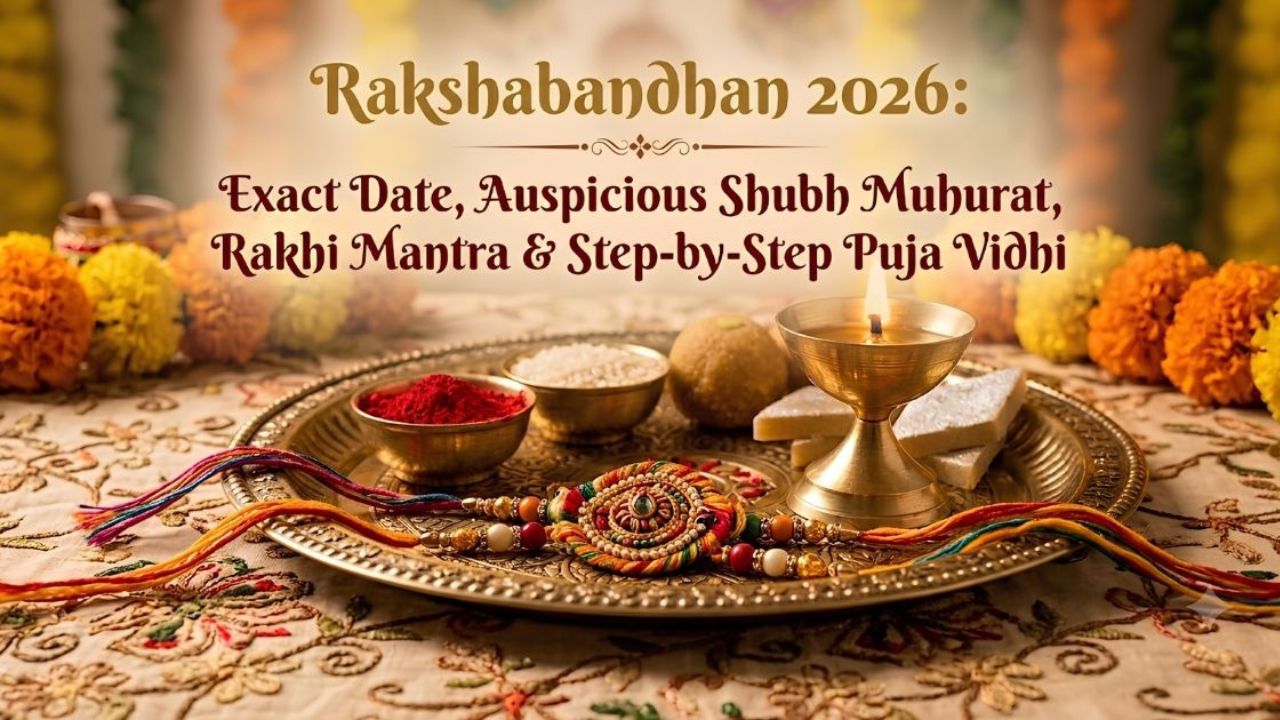
Rakshabandhan 2026: Exact Date, Auspicious Shubh Muhurat, Rakhi Mantra & Step-by-Step Puja Vidhi
Half of India is going to tie rakhi on the wrong day this year—not because they don't care, but because the Shravan Purnima tithi spans across two calendar days in 2026.
Here is everything you actually need—the verified date for Rakshabandhan 2026, the exact auspicious muhurat, the authentic mantra, the proper step-by-step vidhi, and why the "blood relation only" rule you grew up hearing isn't even historically accurate.
Rakshabandhan 2026 Date Confirmation: August 27 or August 28?
Shravan Purnima begins on the morning of 27 August 2026 at 9:08 AM and remains active through the morning of 28 August 2026 until 9:48 AM. That overnight overlap is precisely what causes the annual confusion.
The ancient Panchang rule that settles the debate once and for all is the principle of Udaya Tithi: when a tithi spans across sunrise on two consecutive days, the festival is officially observed on the calendar day the tithi is present at sunrise.
27 August: Sunrise occurs before Purnima begins.
28 August: Sunrise falls squarely within the active Purnima tithi.
So the answer is completely clean: Rakshabandhan 2026 is on Friday, 28 August.
Rakshabandhan 2026 Shubh Muhurat, Morning Window & Bhadra Timing
Rakshabandhan 2026 falls on Friday, August 28, with the auspicious time restricted to a morning-only window (5:57 AM to 9:48 AM) because the Purnima Tithi ends before noon. (Note: Exact local timings can shift by 10 to 20 minutes depending on your specific city's coordinates, so check your local panchang for precise minutes.)
Now for the part most people miss: Bhadra Kaal—the astrological period considered inauspicious for sacred thread rituals—falls during the night of 27 August and clears completely before sunrise on 28 August. Which means, for once, there is zero Bhadra to dodge on festival day. However, because the Purnima tithi ends early, the clean, auspicious window to tie Rakhi on Friday, 28 August is strictly limited to the morning from 5:57 AM to 9:48 AM.
A Quick Fact-Check on the 2026 Eclipse: A partial lunar eclipse occurs on 28 August 2026, but it is not visible in India. According to traditional Vedic principles, eclipse precautions (Sutak) apply exclusively to regions where the phenomenon is geographically visible to the naked eye. It has zero bearing on your Rakhi timings or rituals.
Astrological Significance of Bhadra Kaal on Rakshabandhan
If you have ever wondered why elders get so strict about avoiding Bhadra Kaal, there is deep-rooted scripture behind it.
According to texts like the Skanda Purana, Bhadra is the sister of Shani Dev (Saturn) and daughter of Surya Dev (the Sun). Her energy during Bhadra Mukha (the face/mouth of Bhadra) is fierce and destructive. Folklore holds that tying a protective thread during Bhadra Kaal brings ruin—a fate associated with Ravana’s downfall after receiving a thread during this inauspicious window. Ever since, avoiding Bhadra is treated as essential for the brother’s wellbeing.
Authentic Vedic Raksha Sutra Mantra with English Meaning
Traditionally, there is a specific Vedic shloka meant to be recited right as the thread is tied around the wrist:
येन बद्धो बली राजा दानवेन्द्रो महाबलः।
तेन त्वामभिबध्नामि रक्षे मा चल मा चल।।Yena baddho Balī rājā dānavendro mahābalaḥ |
Tena tvāmabhibadhnāmi rakṣe mā cala mā cala ||Meaning: "With the same protective thread that bound the mighty demon-king Bali, I bind you — O protective thread, remain steadfast and never falter."
Rakshabandhan Puja Vidhi: Step-by-Step Ritual Sequence
The ritual sequence carries symbolic weight. Follow these step-by-step practices:
1. Thali Preparation: Prepare a thali containing the sacred Rakhi, Roli (vermilion powder), Akshat (unbroken raw rice), a lighted Ghee Diya (lamp), and Mithai (sweets).
2. Seating Direction: The brother sits facing East or North. He covers his head with a clean scarf or cloth as a mark of respect.
3. Tilak First: Apply the red Roli tilak onto the center of his forehead, followed immediately by pressing a few grains of Akshat onto the mark.
4. Aarti: Perform a small, clockwise aarti with the lighted diya to ward off negative energy.
5. Tying the Thread: The Rakhi is tied strictly on the right wrist while reciting the Raksha Mantra.
6. Feeding Sweets: Feed sweets by hand to symbolize sweetness in speech and mutual goodwill.
7. Gift & Pledge: The brother presents a gift or shagun, accompanies it with a vow of protection, and seeks or offers blessings.
Ancient Scriptural Legends: Lord Indra-Sachi & King Bali Stories
While the story of Draupadi tearing a strip of cloth for Lord Krishna is widely known, it is far from the only or oldest scriptural origin of the sacred thread.
1. Lord Indra and Sachi (Indrani): One of the earliest accounts of the Raksha Sutra appears in the Bhavishya Purana during a war between the Devas and Asuras. Indra's wife, Sachi (Indrani), tied a sacred cotton thread blessed with mantras around Lord Indra's right wrist before he went to war against Vritrasura. Fortified by its power, Indra was victorious. This ancient Vedic origin proves that protective threads were originally tied for protection in battle—and were not strictly limited to brother-sister bonds.
2. Goddess Lakshmi and King Bali: As recounted in the Puranas, Lord Vishnu agreed to guard King Bali's gates in the underworld. Goddess Lakshmi traveled to the underworld disguised, tied a cotton thread onto King Bali’s wrist as a brother, and prayed for his long life. In return, Bali granted her a gift, releasing Lord Vishnu. This legendary pact is commemorated in the sacred Raksha Mantra recited today.
Busting the Myth: Can You Tie Rakhi to Non-Blood Relations?
The strict modern belief that Rakshabandhan belongs exclusively to biological siblings is actually a narrow, relatively recent reading of the custom.
Historically and scripturally, protection threads extended across many relationships: Rajput women sent Rakhis to neighboring rulers as non-aggression pacts, women tied Lumba Rakhis to sister-in-laws (Bhabhis), and priests tied Raksha Sutras to their patrons. Tying a rakhi to your cousin, friend, or bhabhi directly reflects the festival's expansive original spirit.
Follow us for regular updates ~ Instagram, Facebook, YouTube

Share this post
About the Author

Rakshabandhan 2026: Exact Date, Auspicious Shubh Muhurat, Rakhi Mantra & Step-by-Step Puja Vidhi

Topics
- Akshaya Tritiya
- Aura Scanning
- Real Rudrakshas
- Pitra Paksha, Shraddh, Kanagat
- Navratri
- Shubh Muhurat
- Significance of Parad Idols
- Dussehra, Diwali, Dhanteras, Bhai Dooj
- Planetary Transits, Retrograde & Direct Movements
- Logo Shastra
- Vastu Shastra
- Festivals
- Mahashivratri
- Vastu Pyramid Yantras
- Yantra
- Astrology
- Gemstone
- Teej
- Nag Panchami
- Vedic Yagya
- Janmashtami
- Daily Prediction for 12 Zodiac Signs
- Daily Numerology Predictions for all Numbers
- Weekly prediction for all zodiac sign
- Solar Eclipse
- Karwa Chauth
- Diwali
- Vastu Tips
- Tulsi Mala
- Religious
- Chaitra Navratri
- Free Tips
- Rakshabandhan
- EKADASHI
- Ganesh Chaturthi
Tags

Comments